
DeepMind vs Microsoft: Competing AGI Approaches
18 Dec 2025- DeepMind’s Hassabis pursues scientific AGI—root-node research, robustness and discovery—while Microsoft’s Suleyman focuses on deployable, certified, economically productive agents with containment and governance.
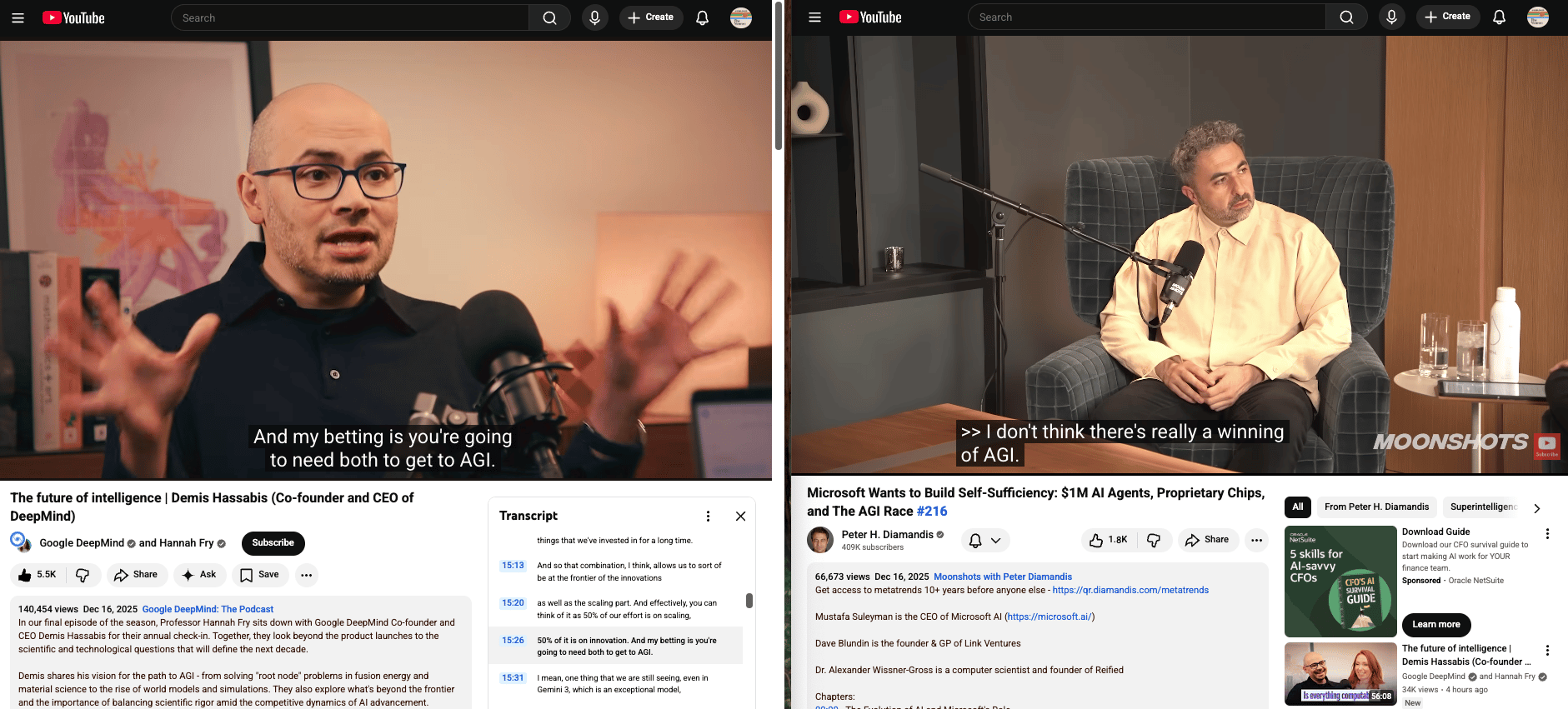
Two recent interviews with Demis Hassabis (Google DeepMind) and Mustafa Suleyman (Microsoft AI) reveal sharply different strategies for pursuing AGI. Hassabis frames DeepMind’s path as scientific: split investment between scaling infrastructure and basic research, target “root node” problems (e.g., fusion, superconductors), fix brittle or “jagged” model behaviour, and build physics-style benchmarks so systems truly understand domains rather than just appearing plausible. He’s hunting for AlphaZero-like discovery modes where models generate new knowledge rather than compressing human data.
Suleyman’s Microsoft-centric playbook is more product- and economy-oriented. He emphasizes shipping controllable, certified conversational agents that deliver economic value now, keeping humans accountable via containment, strict liability, and governance. Microsoft aims for self-sufficiency (training frontier models end-to-end) and reframes AGI progress as ongoing capability proliferation rather than a “race.” Suleyman even proposes an economic benchmark—give an agent $100K and see if it can autonomously turn it into $1M—as a practical test.
The split matters because Google is doubling down on scientific breakthroughs and long-term robustness, while Microsoft prioritizes deployable, certified agents that create immediate economic outcomes under human oversight. Both views influence product roadmaps, safety priorities, and how the industry defines — and measures — AGI progress.
The method
The prompts
